
How To Write an Artist Statement for Juried Shows (Based on Real Juror Feedback)
Most advice on artist statements tells you to "be authentic" and "show your voice." It doesn't tell you what a juror actually looks for when they're reading 200 statements in one sitting.
We reviewed thousands of statements submitted through EntryThingy across hundreds of juried shows. Here's what we found.
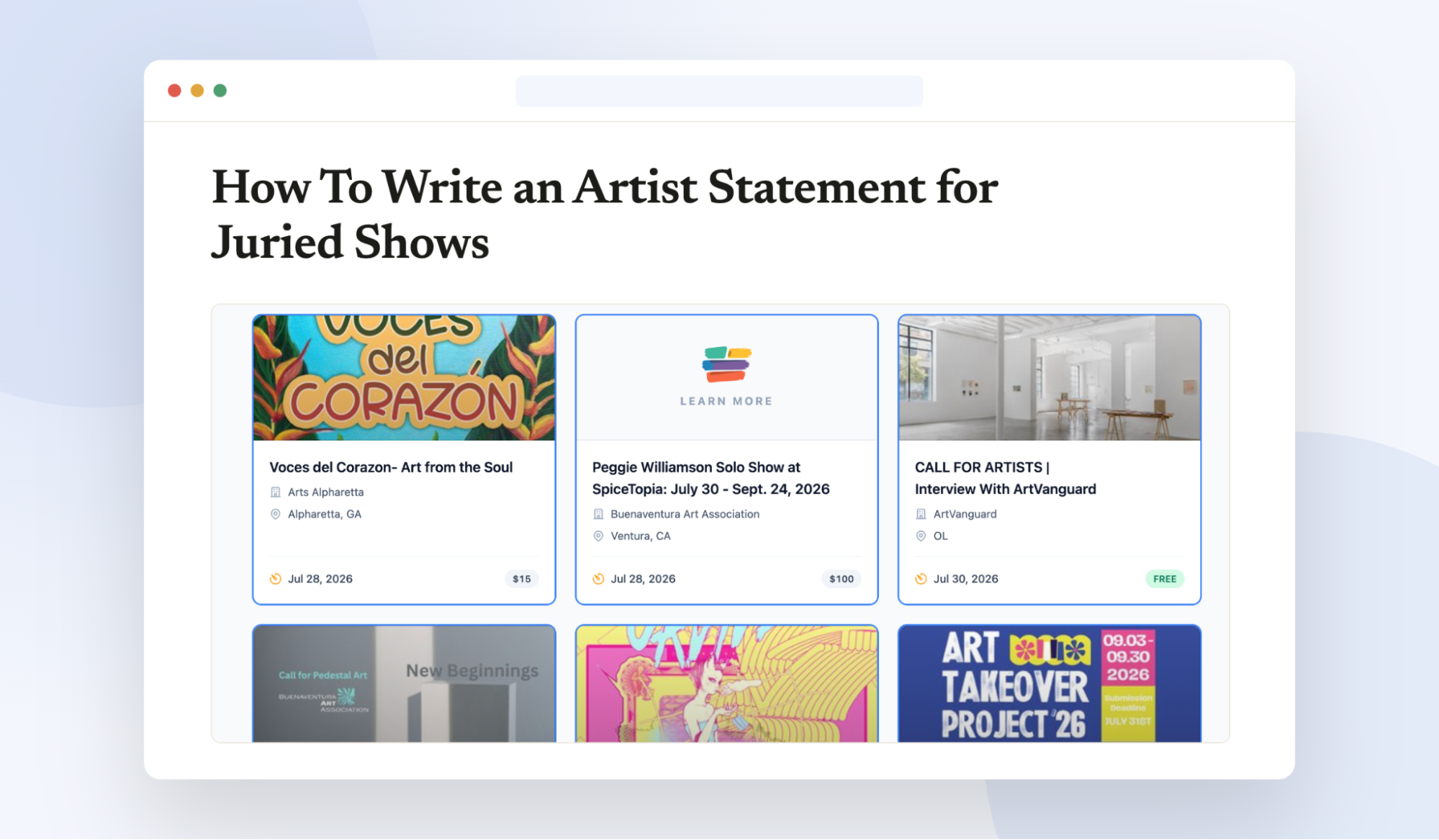
What We See Across Thousands of Artist Statements (And What Jurors Actually Notice)
EntryThingy hosts juried shows across hundreds of calls each year. We see statements from artists at every stage, emerging, mid-career, established, across every medium.
The patterns below are what come up consistently when statements help or hurt an application.
A juror reviewing a competitive show may read 100 to 300 statements in a single session. They are not looking for impressive language. They are looking for clarity, the statement that answers their questions fastest is the one that helps the work land.
From what we hear from galleries and jurors, the issues that come up most often are:
- Statements that never name the medium, leaving the juror to guess from the images alone.
- Themes like "identity, memory, and transformation" that could describe any artist in any medium and give a juror nothing specific to hold onto.
- Biography that takes up the whole statement without explaining why the work looks the way it does.
- Submissions where the pieces feel disconnected, three different styles, three different subjects, with no sentence explaining what connects them.
- Artists submitting without a statement at all, which shows an incomplete application before a juror looks at a single image.
The six tips below address each of these directly.
1. Name Your Medium Before the Juror Has to Guess
This is the most common mistake we see, and one of the easiest to fix. A juror looking at your application has your images and your statement. If the statement does not name the medium, they have to guess it from the images alone.
For painting or photography, they can usually guess. For mixed media, ceramics, enamel work, fiber, or anything involving multiple materials or processes, a juror without context may misread the work entirely.
What this looks like when it goes wrong:
"My work lives at the intersection of spontaneity and structure. I am drawn to the tension between what is planned and what emerges on its own, seeing what can rise out of motion, how precision coexists with accident, and how a mixture of materials can reveal the story beneath the surface."
This is well-written and the concept is clear, but after reading it, a juror still does not know if they are looking at painting, sculpture, collage, or assemblage. The medium appears nowhere.
Compare that to Ann Aas, whose statement opens with:
"I found my passion when I took my first enameling class. I enjoy playing with fire and the unpredictable and endless potential of hot glass fused to metal. I begin with hand-cut or punched copper, brass and steel bases."
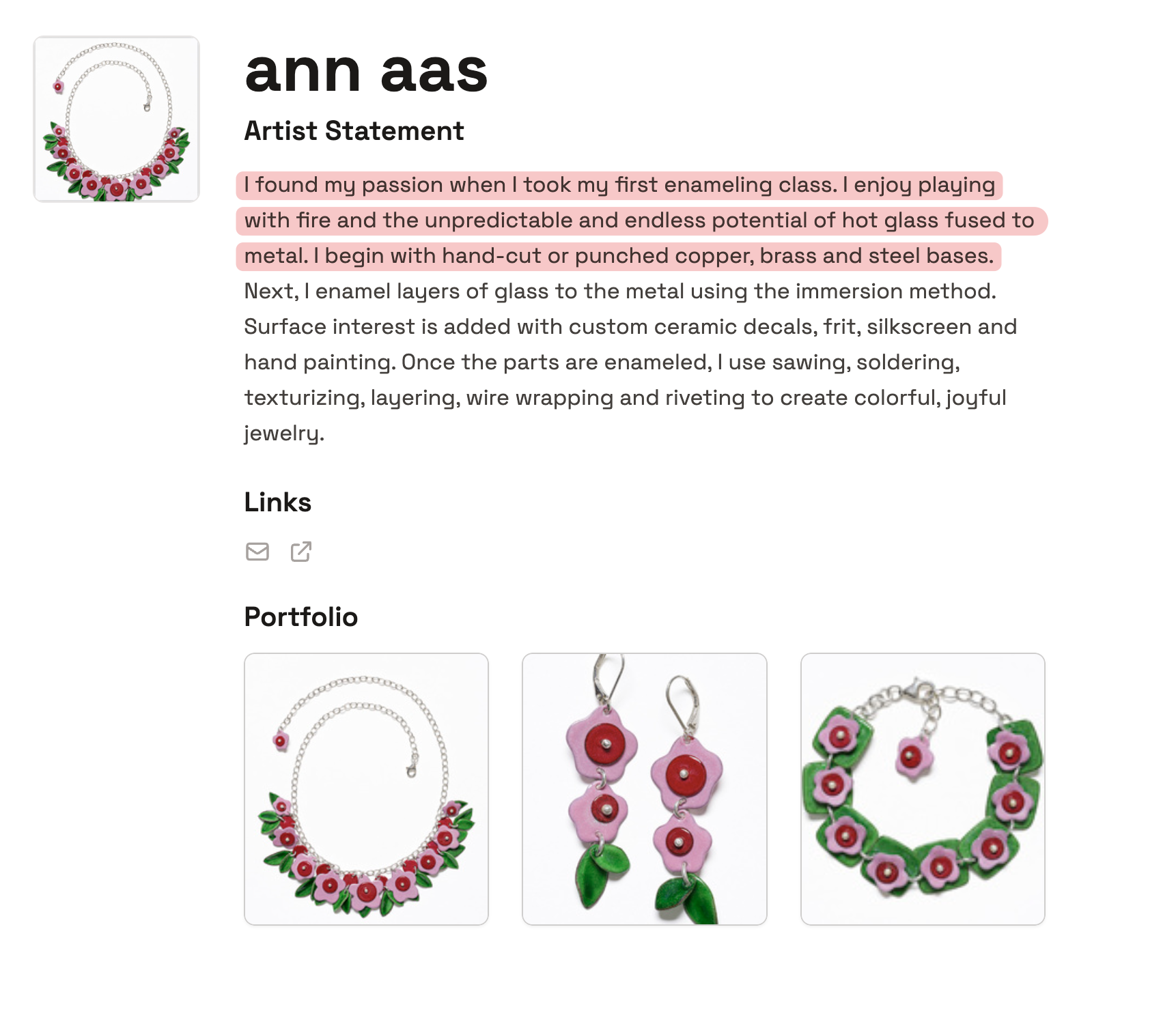
By the third sentence the juror knows the medium, the specific materials, and the process.
When writing your own, consider:
- Naming the medium in your first or second sentence
- Including the specific materials if they are unusual or part of the meaning
- Describing the process in one sentence if the medium alone does not explain what the work looks like
2. Give the Work a Subject, Not a Theme
A theme is a broad idea like "the passage of time" or "our relationship with nature." It could describe thousands of artists working in thousands of mediums and gives a juror nothing specific to picture.
A subject is something like "the coastal edges of Vancouver Island, where forest, ocean, and wildlife meet." A juror reading that sentence can picture the work before they see it.
This difference matters more than most artists realize. When we look at artist statements that consistently work across different calls and different jurors, they almost always anchor around a specific subject rather than a broad theme. The theme might be present in the subtext, but the subject is what a juror can evaluate.
What this looks like when it goes wrong:
"She is a contemporary abstract artist who uses bold colors, dynamic forms, and layered textures to express the unseen emotions, memories, and energy. Her work is an exploration of the inner world, utilizing abstraction as a language to convey meaning beyond words."
Emotions, memories, energy, inner world, meaning beyond words, these are themes stacked on themes. Nothing here is specific enough to distinguish this artist from hundreds of others working in abstract painting.
To test whether your statement has a subject or just a theme, ask yourself these questions:
- Could another artist copy this sentence without changing anything?
- Can a juror picture a specific image from your opening line? If not, you are still in theme territory.
3. Let Your Process Explain Your Meaning
Most artists describe what they do without explaining why it matters. Process described without meaning is a list of techniques, process connected to meaning is a statement. The juror does not need to know your process for its own sake. They need to know what it produces, and why that outcome is the point.
Take Mika Altidor as an example for collage:
"Collecting and cutting out thousands of various bodies and objects and animals I only take from what already is, I don't form or draw any elements myself, in this way making collages turns into completing a puzzle where the pieces may take weeks, months, or even years to coalesce."
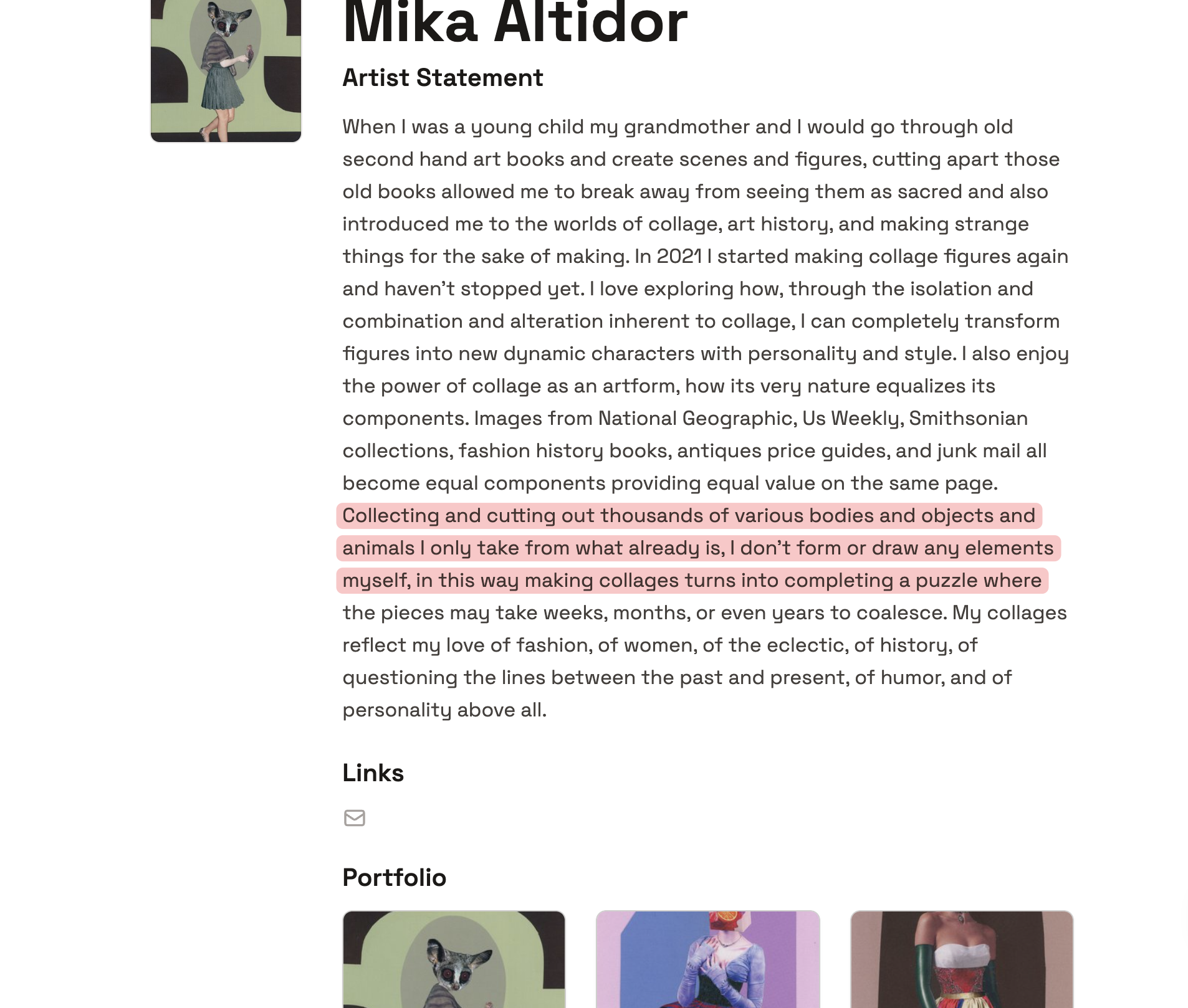
The constraint she describes (only using existing images, never drawing her own) explains the philosophy of the work in a single sentence. That is what connecting process to meaning looks like.
What this looks like when it goes wrong is a statement that lists influences without connecting them to the work:
"As an art historian with many years in the performing arts, I have traveled the world through great works of art. Dance, music and theater motifs often surface in my art. I return time and again to natural landscapes, the rhythms of jazz, creatures of the sea, and colorful flowers and leaves."
This gives the juror a rich list of references but no picture of the work itself.
After describing your process, make sure you can answer: what does the process produce visually, and what does the viewer see or feel as a result? One sentence connecting those dots is what turns a technique list into a statement.
4. Start With the Work, Not Your Biography
An artist statement explains the work. An artist bio explains the artist. They are not the same document, and mixing them up is one of the most common reasons statements fall flat.
Biography earns its place in a statement only if it directly explains why the work looks the way it does. Everything else belongs in your artist bio.
What this looks like when it goes wrong:
"Ann is originally from Germany and just started out as a professional artist in 2023. A year later she broke into the international art market and won an award here at Parklane Gallery. Her art captures moments of the human experience."
Three sentences, two of them biography, one a theme. The medium, the visual quality of the figures, the specific subject, all absent. A juror reading this has very little to evaluate before the images load.
Mika Altidor (the example above) also opens with a personal memory, but it works because the memory directly explains the medium. Going through secondhand art books with her grandmother, cutting the pages apart, that origin story is the process explanation. Biography earns its place when it answers the question: why does the work look the way it does?
Before including any biographical detail, ask:
- Does this directly explain why the work looks the way it does?
- Would a juror understand the work better with or without this sentence?
- Does this belong in my artist bio instead?
If the answer to that last question is yes, move it there.
5. Tell the Juror Why These Specific Pieces Belong Together
This is the sentence most artists leave out entirely, and it is the one that most directly helps a juror understand a submission. A juror reviewing an entry-juried show evaluates the submission as a whole.
Do these pieces come from the same place? Is this a coherent body of work or a random collection?
From what we hear from galleries, submissions that feel disconnected (where every piece looks like it came from a different practice) are one of the most consistent complaints. Too many clashing styles with no thread connecting them makes it hard for a juror to make a decision, even when individual pieces are strong.
What this looks like when it goes wrong:
"Contemporary interdisciplinary art duo working in digital photography, collage, and mixed media with a focus on cultural and political commentary."
One sentence. Names the mediums. Names a focus. Tells the juror nothing about which works were submitted, why those works, or what connects them in this specific application.
Compare that to Peggy Albers:
"The scope of this submitted work represents years of moving towards a more focused attention on primates, which I intend to continue in future."
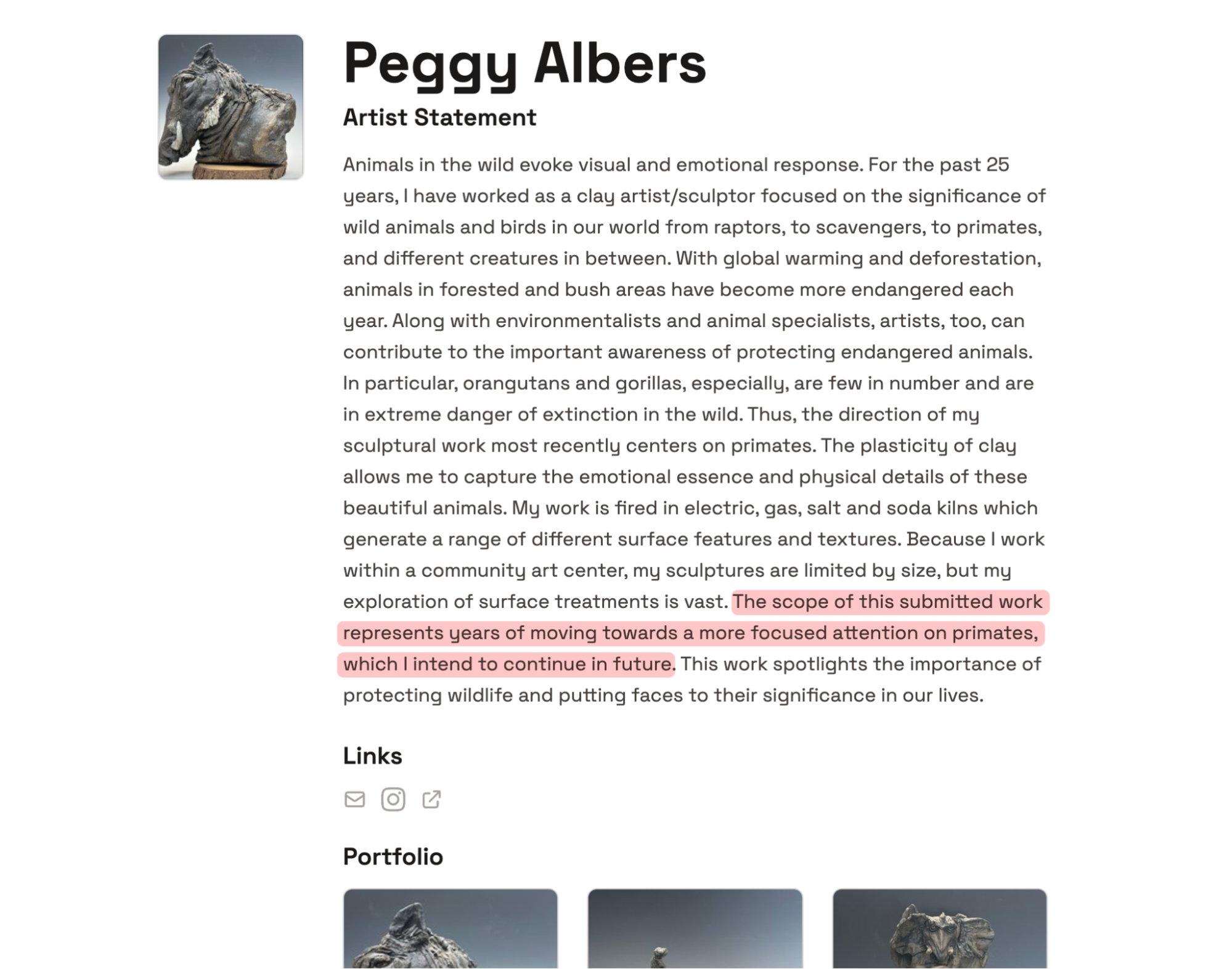
That single sentence tells the juror the submission is deliberate, a selection from a focused ongoing series, not a group of unrelated pieces.
A strong closing sentence for any statement should answer: what connects the submitted pieces visually or thematically, and why were these specific works chosen for this call?
6. Build One Strong Statement You Can Adapt, Not One for Everything
The weakest statements we see are the ones that could have been written by any artist, for any call, in any medium. They are generic because they were written to be generic, to work for everything, which means they work for nothing.
This also connects directly to one pattern in rejected applications: work that does not match the theme of the show. A catch-all statement reused for every call often signals that the artist did not check whether their work was a genuine fit before applying.
What this looks like when it goes wrong:
"I create handcrafted modern jewelry and accessories that blend minimalism with warmth, personality and everyday wearibility. Dainty jewelry designed to feel light, personal and perfect for layering or daily wear."
This reads like a product description. There is no process, no intent, no connection to a specific body of work or call. For a juried show, a juror needs more than a style summary.
Guillaume Allamel's statement takes the opposite approach. It is built around an approach, not a medium or a series — he describes himself as an interpreter of the overlooked:
"shadows on concrete, wind moving through grass, the quiet labor of roots beneath the soil."
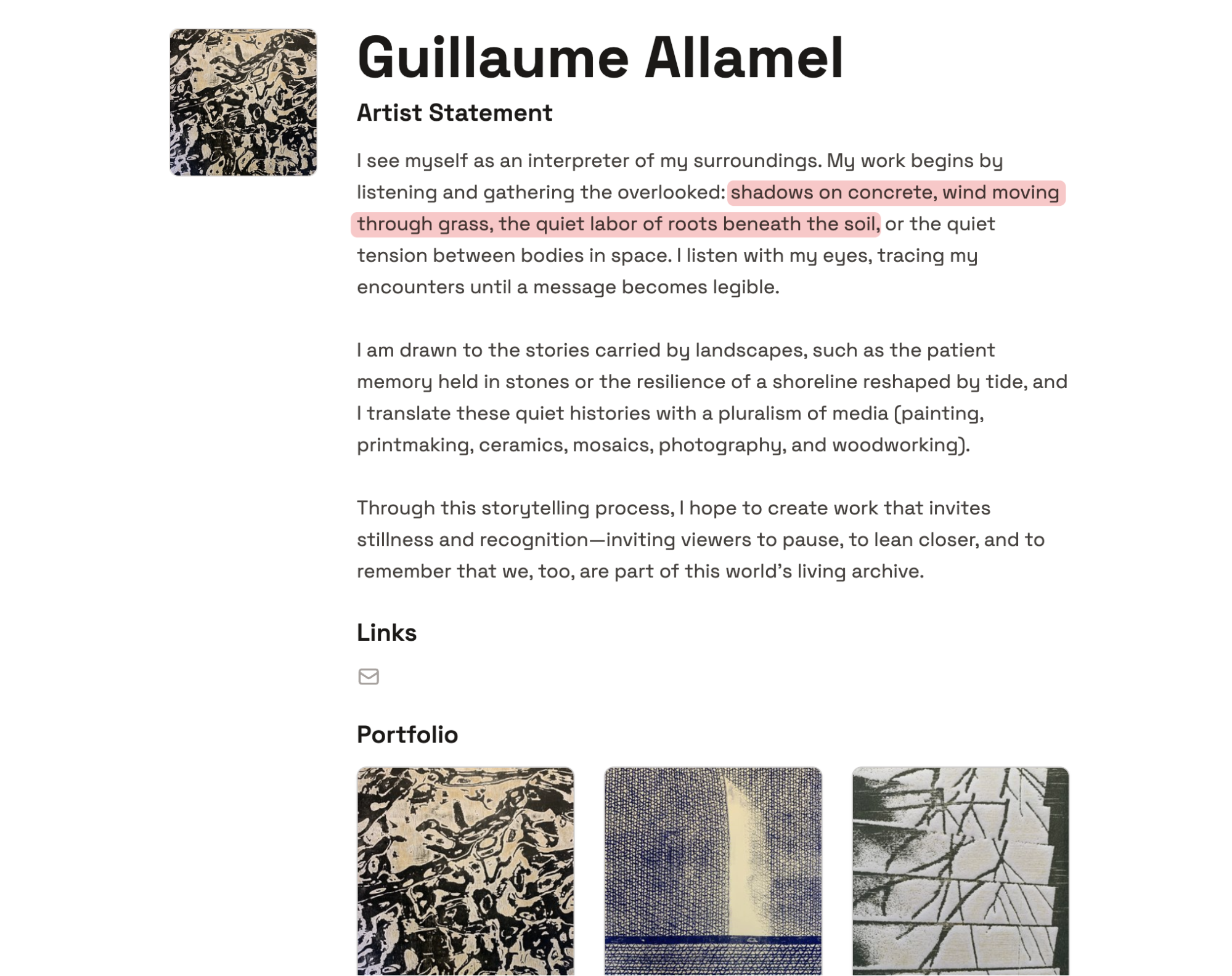
That framing is specific enough that a juror understands what kind of work to expect, but broad enough that the final paragraph can be adapted for each specific submission and call.
When adapting your base statement for a specific call, check:
- Does the statement reference the call's theme or the gallery's focus area?
- Does the final paragraph name the specific works submitted and why you chose them?
- Would a juror reading this understand why you applied to this specific show?
Before You Write Your Next Artist Statement, Do This
Look at the pieces you are submitting and fill in these three sentences:
- My work is made in (medium) and focuses on (specific subject or place).
- I make it by (process), which produces (visual result).
- These pieces belong together in this submission because (what connects them).
Write one paragraph answering those three questions. Then add one sentence at the end explaining why these pieces fit this specific call. That is your statement.
If you are not sure where to start, our artist statement examples show 11 real statements from working artists across painting, sculpture, jewelry, collage, digital art, and mixed media, with a breakdown of what each one does well and what you can adapt for your own.
Once your statement is ready, add it to your EntryThingy profile. It saves automatically and carries across every call you apply to, so you never have to rewrite it from scratch.
Create Your EntryThingy ProfileFAQs About Artist Statements
What do jurors look for in an artist statement?
Jurors look for clarity. Specifically: the medium, a specific subject rather than a broad theme, some explanation of the process or intent, and a sense of why the submitted pieces belong together. They are not looking for impressive language. They are looking for work that is easy to understand quickly.
How long should an artist statement be for a juried show?
Most calls ask for 150 to 300 words. Always check the call requirements before you write. Going over the word limit shows to a juror that you did not read the instructions.
What is the most common artist statement mistake?
The most common mistake is being too vague. Phrases like "identity, memory, and transformation" or "the human experience" appear in hundreds of statements and give the juror nothing specific to hold onto. The answer is always the same: replace the theme with the subject.
Should I write a different artist statement for every application?
You do not need to rewrite from scratch every time. Build a strong base statement around your approach and subject, then adapt the final paragraph for each submission, naming the specific works and explaining why they fit this call. That combination of consistent core and specific adaptation works across every application without feeling generic.
What is the difference between an artist statement and an artist bio?
An artist statement explains the work. An artist bio explains the artist. For help with the other two, see our artist resume examples.