
Applying to art calls is one of the most practical ways to build your exhibition record, gain visibility, and connect with new audiences.
But as online listings have grown, so has the gap in quality. Some calls are run by real galleries and lead to documented exhibitions, while others exist mainly to collect fees with little to no benefit for artists.
The goal of this guide is simple: help you quickly recognize the difference. We’ll walk through specific warning signs of low-value or “pay-to-play” listings, along with clear indicators of legitimate, well-managed calls.
By knowing what to look for, you can confidently apply to opportunities that actually help your artistic career—whether you're building your first artist bio or expanding your exhibition history.
Especially if you're planning to show your work publicly or preparing your portfolio for upcoming exhibitions (our guide on how to apply to art calls offers additional context if you want to dive deeper).
Quick Overview: Scam vs Legit Art Calls
| Scam / Low-Value Calls | Legitimate Calls |
|---|---|
| No clear venue or exhibition plan | Named gallery or institution, plus how the work will be displayed |
| No identifiable jurors or selectors | Named jurors, curators, or review panel you can research |
| “Free to apply” → fees appear after acceptance | Entry fees (if any) are disclosed clearly before you apply |
| Most or all applicants are accepted | Selective review process with real declines |
| Online-only with no stated audience or documentation | Physical exhibition or documented hybrid with visibility |
| Dozens of overlapping or monthly “shows” | Limited number of thoughtfully scheduled exhibitions |
| No explanation of what acceptance includes | Clear outcomes (exhibition, documentation, catalog, awards, or promotion) |
What Makes an Art Call Scammy? (Specific Warning Signs)
Not every low-value call is intentionally deceptive, but there are consistent patterns that separate questionable listings from legitimate ones.
Below are the most reliable red flags, the ones that show up repeatedly across “pay-to-play,” fee-driven, or poorly structured exhibitions.
1. “Free to Apply” — Then Fees After Acceptance
A legitimate call either lists its fee upfront or is genuinely free from start to finish.
If a listing promotes free submissions but later requires payment for “listing,” “catalog inclusion,” or “featured placement,” that’s a strong warning sign.
2. No Physical Gallery or Verifiable Location
Even if a show has an online component, there should be a real gallery, museum, or institution behind it. You should be able to find:
- A physical address,
- An organization name, or
- A track record of past shows. If everything is virtual with no physical footing, it’s often fee-driven.
3. Too Many Shows Running at the Same Time
A standard gallery runs one show at a time (maybe two at most). When a site has:
- Three or more shows open simultaneously,
- Constant “monthly exhibitions,” or
- Several unrelated “theme calls” at once (it usually signals volume-based intake, not curation.)
It’s usually a sign that the organizers are prioritizing volume over curation. Legitimate exhibitions take planning, communication, and real physical coordination.
Scam or low-value platforms can only sustain this many overlapping calls because there is no actual exhibition infrastructure behind them.
4. Shows Advertised in Multiple Cities at Once
If a single organizer claims shows in:“NYC + Chicago + LA + London + Paris”, it’s almost certainly a revenue model, not a curated exhibition.
Real galleries don’t operate meaningful exhibitions in multiple cities at the same time unless they’re major institutions.
5. No Real Information About How the Work Will Be Exhibited
You should avoid art call if the listing doesn’t explain:
-
Whether the exhibition is physical or hybrid,
-
Where or how viewers will access it,
-
Whether documentation will exist,
-
Whether there will be audiences, receptions, or promotion (the “exhibition” may consist of nothing more than a webpage).
6. No Identifiable Jury or Selection Criteria
“Reviewed by our team” means nothing. Legitimate calls name:
- jurors,
- curators,
- or at least specific roles.
If there’s no identifiable selection process, the “jurying” may not exist at all.
7. Hidden or Add-On Fees After Acceptance
A transparent fee model is one of the strongest signals of legitimacy. If costs appear later as:
- “optional add-ons,”
- “promotion upgrades,”
- “catalog placement fees,” (it signals a transactional model rather than a curated one.)
What Makes an Art Call Legitimate? (Specific Signs You Can Verify)
Legitimate calls are not vague or hidden behind unclear language. They provide enough structure and information for artists to confidently understand what they are participating in.
When organizers are transparent, selective, and tied to real-world venues, artists can easily evaluate the value of the opportunity.
Here are the clearest signals that a call is professional, credible, and worth consideration:
1. The Exhibition Has a Verifiable Physical Location
Even if an exhibition has an online component, legitimate organizers are tied to a physical address (a gallery, institution, museum, or arts organization). This grounding protects artists and shows that the event exists beyond a digital storefront.
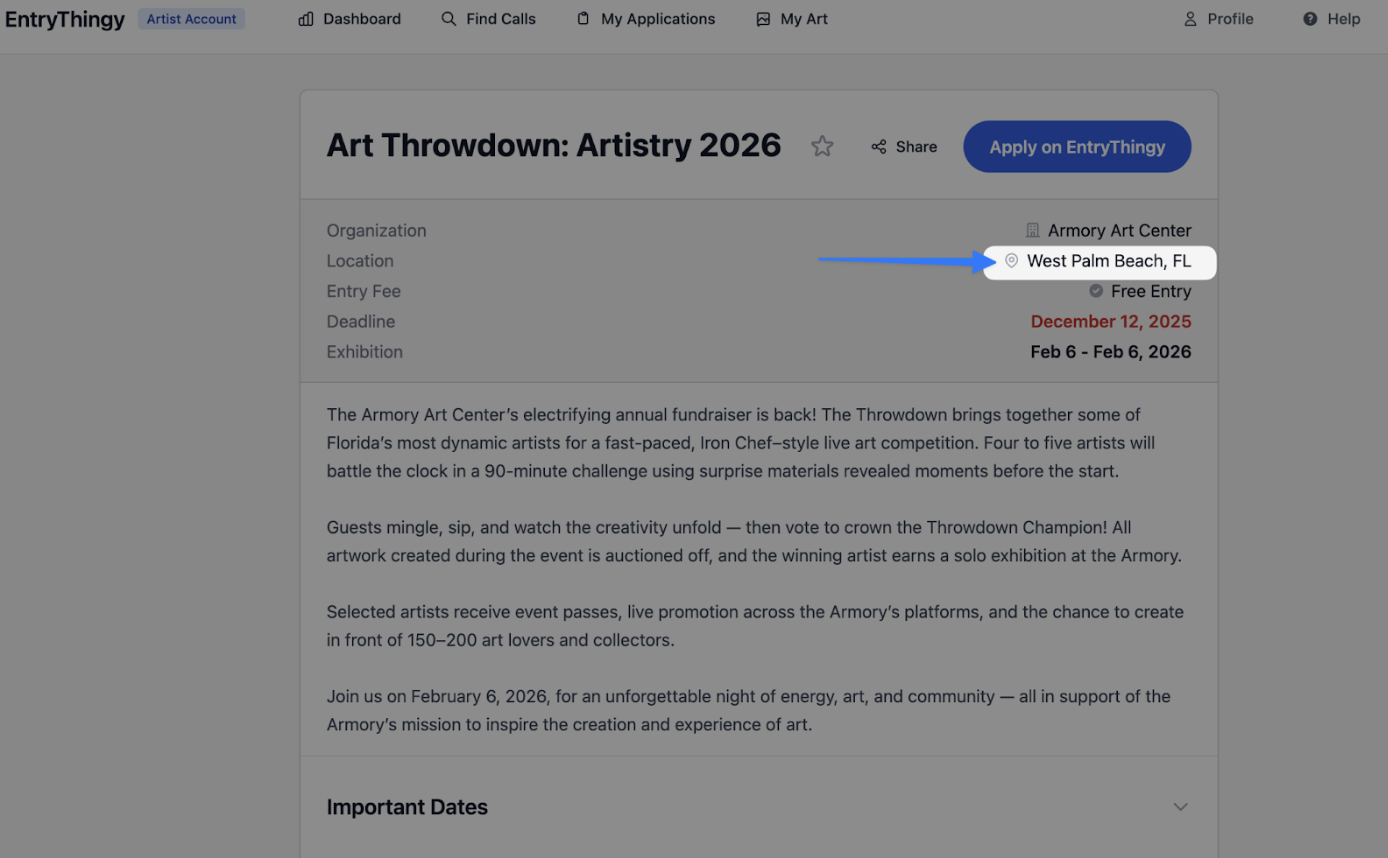
In EntryThingy, artists can verify this instantly.
When you sign in and open a call, the Location field appears clearly at the top of the listing, just like in the screenshot above.
You can see the hosting organization (“Armory Art Center”) and its physical city (“West Palm Beach, FL”) before you even start an application.
This level of clarity makes it easy to confirm that a real venue and real event are behind the call.
2. Jurors Have Reputations You Can Validate
Legitimate exhibitions name real jurors: curators, educators, gallery directors, or working artists. A strong green flag is when you can:
- look them up online,
- see their work, or
- confirm their institutional affiliation.
Inside EntryThingy, this information is easy to access. When you open a call, you’ll often see the juror’s name, background, or a direct link to the prospectus (just like in the example below).
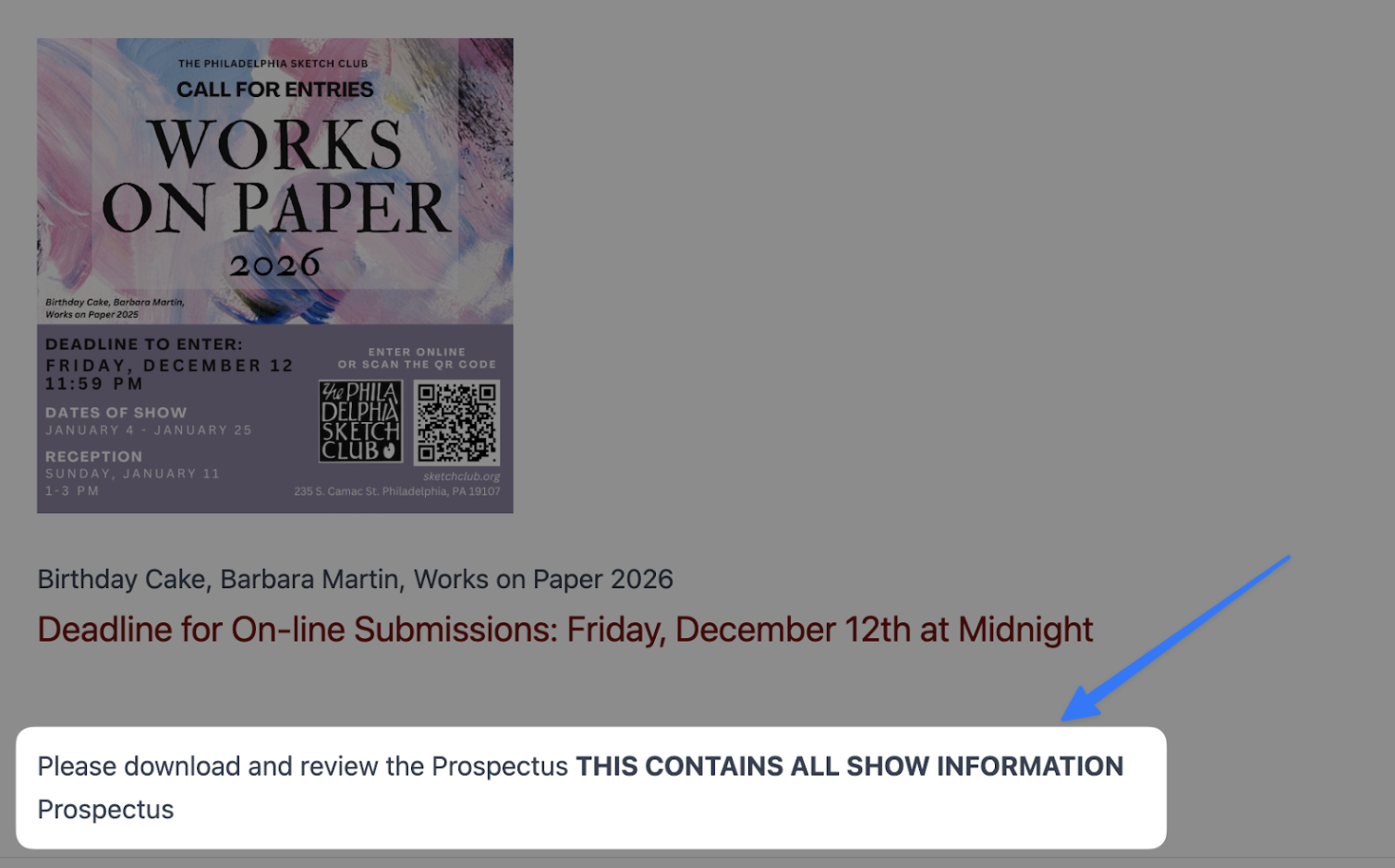
In this listing, artists are prompted to download the prospectus, which contains all show information, including juror details and selection criteria.
This level of transparency helps you quickly verify who will be reviewing your work and whether the exhibition aligns with your professional goals.
If a call provides a clear juror identity or a prospectus with complete details, it’s almost always a sign of a well-managed, legitimate exhibition.
3. The Exhibition Venue and Format Are Clearly Specified
Legitimate calls describe where the exhibition will take place, whether it’s physical or hybrid, and how the artwork will be displayed.
This gives artists realistic expectations about visibility, logistics, and the overall value of participating.
In the example below, the organizer clearly states that the exhibition will take place inside the Padzieski Gallery, located in the Ford Community & Performing Arts Center in Dearborn, Michigan.
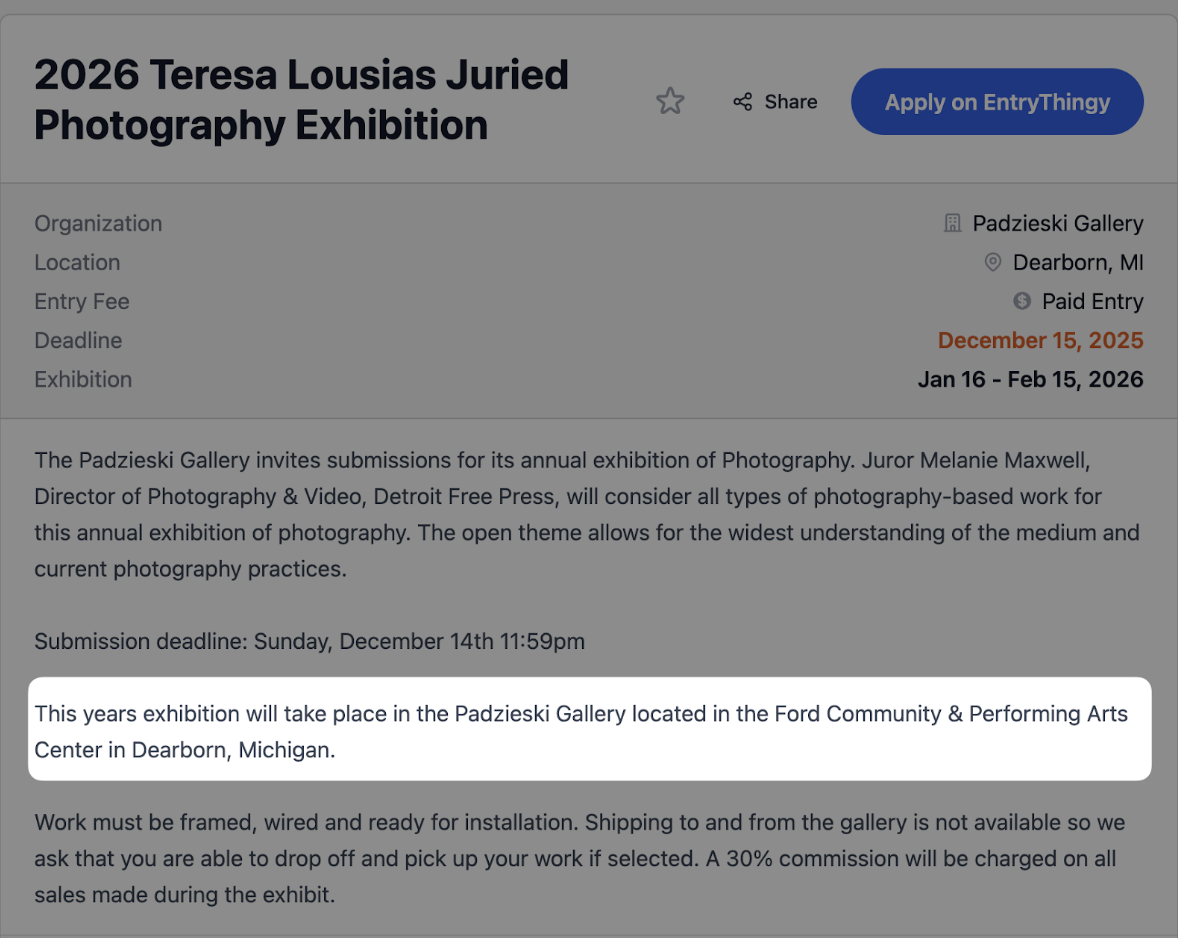
This level of specificity removes guesswork, so artists immediately know the venue, the city, and the type of exhibition they’re submitting to.
When a call provides a named gallery and a real address like this, it’s a strong signal that the event is structured, legitimate, and backed by a physical institution.
4. Timelines Are Structured and Communicated Upfront
Professional exhibitions publish clear dates for:
- submission deadlines,
- jurying periods,
- acceptance notifications,
- and exhibition schedules.
When these details are available upfront, artists can plan shipping, framing, travel, and other logistics with confidence.
When you apply through EntryThingy, this information is organized in one place.
In the example, all the key dates appear directly in the call header, and artists can expand the “Important Dates” section for a complete breakdown of the timeline.
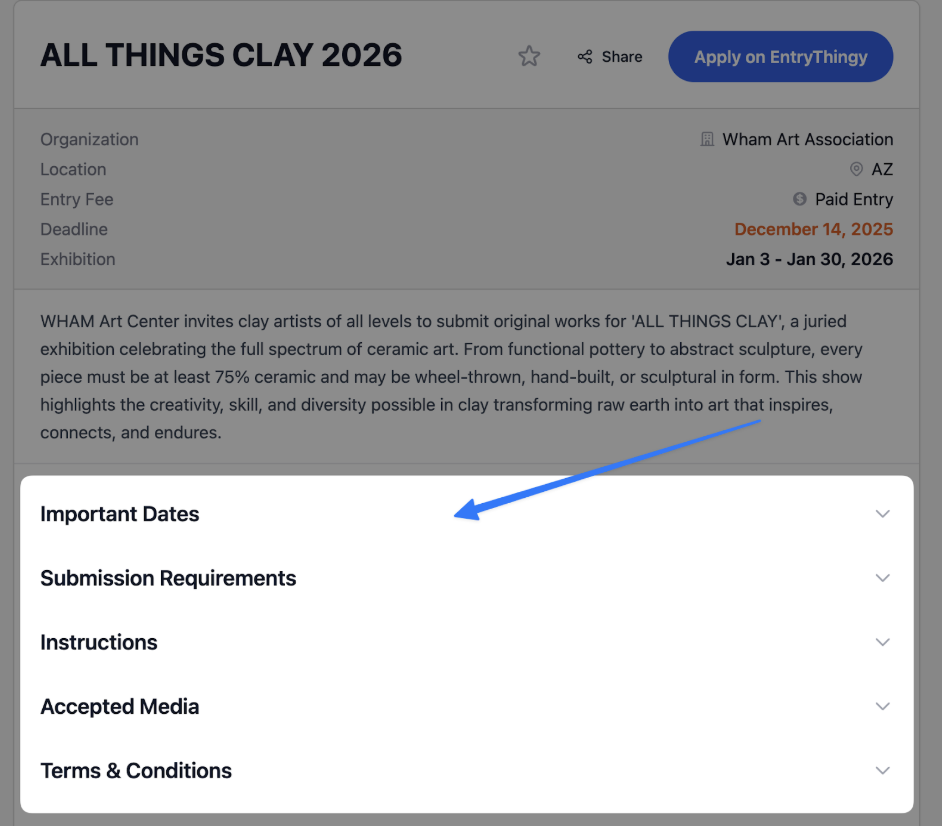
This prevents the confusion some submission tools create when they bury or omit this information entirely.
Having access to the entire scheduling structure before you apply is a strong sign that the organizers are running a legitimate, well-managed exhibition.
💡 Submitting to open calls? Join 166,000+ artists using EntryThingy to apply to shows hosted by 2,500+ galleries worldwide.
Create Your Account for Free5. Participation Comes With Defined Outcomes
Legitimate calls tell artists what they receive if selected, whether it’s:
- documented exhibition presence,
- catalog inclusion,
- awards consideration,
- press outreach,
- gallery promotion.
Artists should understand what “acceptance” means beyond just a line on a resume.
6. Fees Are Transparent, Upfront, and Proportionate
Legitimate calls are clear about fees from the beginning.
A credible exhibition will tell you exactly what you’re paying for, how many works you can submit, and how the payment is processed.
Below is an example of transparent fee communication, the kind of detail every artist should expect before applying:

This level of clarity helps you understand:
- What the entry fee covers,
- How many works you can include,
- Whether the fee is refundable, and
- What payment methods are accepted
When you apply through EntryThingy, fees are displayed in this same straightforward way. There are no hidden charges, no “pay later” surprises, and no platform deductions. What you see on the call page is exactly what you pay.
7. Selective Admission (Not Everyone Gets Accepted)
Legitimate exhibitions curate their shows, and declines are normal and expected.
When a program selects intentionally, it signals that the exhibition has a clear vision, a real jurying process, and that acceptance actually means something.
In the example above, the eligibility section lays out specific requirements for the work being considered. Including materials, size limits, installation needs, originality, and prior exhibition history.
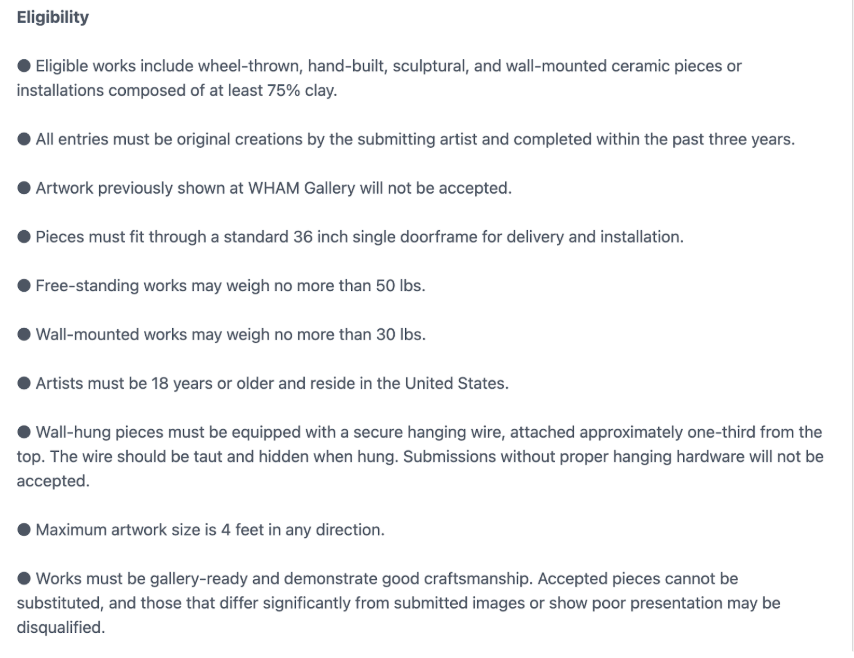
These criteria show that submissions are reviewed against real standards, not accepted automatically.
Clear eligibility rules like these protect both artists and organizers. Artists know upfront whether their work is a good fit, and galleries can curate exhibitions that align with their space, audience, and curatorial goals.
When a call includes detailed acceptance criteria instead of vague “open to all” language, it’s a strong indicator of a serious, well-run exhibition.
Why EntryThingy Aligns With Legit Art Calls (and the Results Show It)
EntryThingy is a legitimate platform used by real galleries and organizations that publish clear details about their exhibitions, jurors, timelines, and expectations.
This makes it much easier for artists to understand what they’re applying to and what they’ll receive if selected.
Here’s what that transparency looks like in practice:
- 2,500+ galleries
- 166,000+ active artists
- 190,000+ submissions
- 4,800+ exhibitions
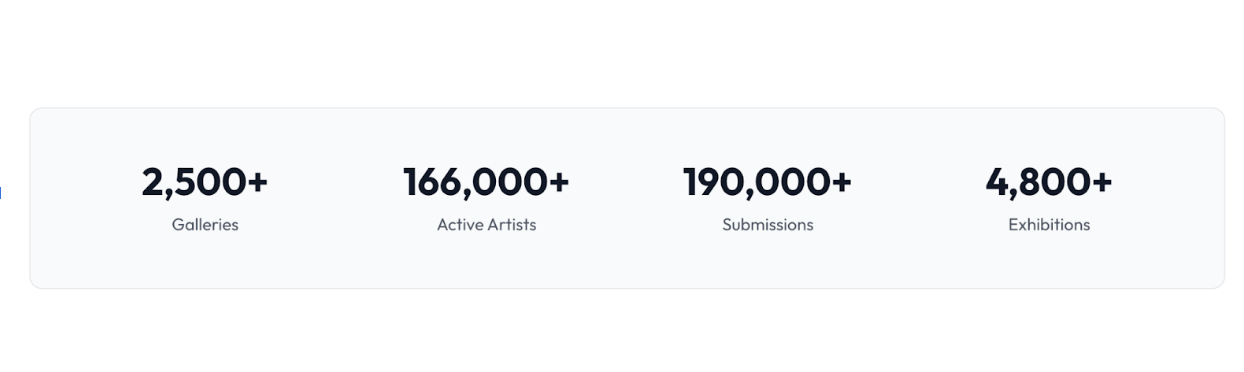
These numbers come from documented exhibitions, not online storefronts or “everyone gets accepted” shows.
Organizations using EntryThingy run structured, curated calls with real venues, real jurors, and real outcomes.
Artists see:
- Where their work will be shown,
- Who is reviewing it
- And what the exhibition provides if selected.
Galleries get a clear submission workflow and direct payments (EntryThingy never holds the artist’s fees).
If you want to see what this looks like in the updated interface, we recently covered the improvements made in the new EntryThingy platform launch.
This is the kind of structure and clarity that legitimate art calls share — predictable details, transparent communication, and results that can be verified.
💡 Submitting to open calls? Join 166,000+ artists using EntryThingy to apply to shows hosted by 2,500+ galleries worldwide.
Create Your Account for Free